
Proprietary Technology
ID-Nova Warm Spray
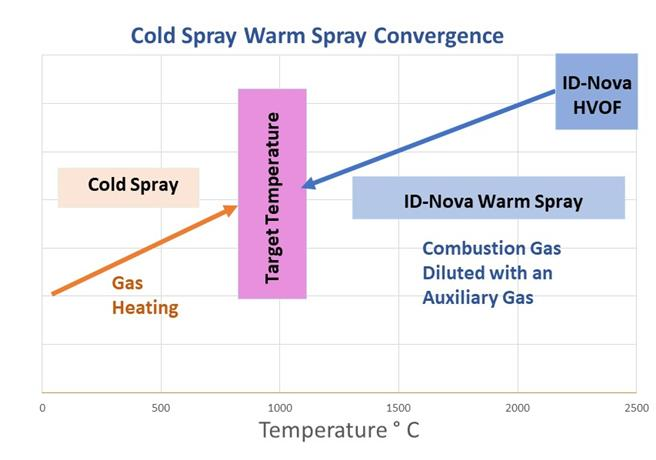
A lower-cost alternative to cold spray. Auxiliary nitrogen, argon, or carbon dioxide is added to the HVOF combustion stream. Gas temperature drops. Gas velocity rises. The same ID-Nova torch runs a solid-phase metal deposit.
Why Warm Spray Exists
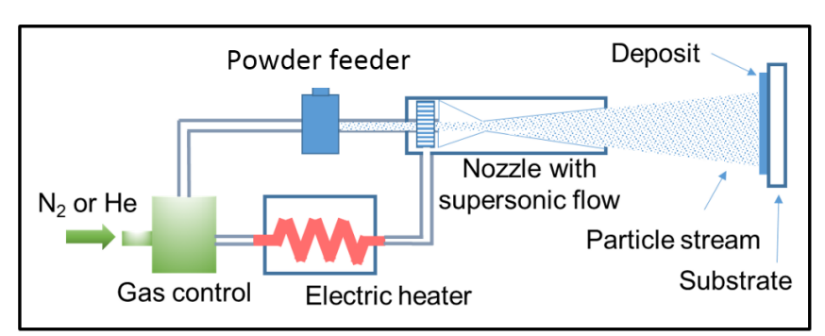
Cold spray is a solid-phase metal process. Metal powder is injected into a heated, high-velocity gas stream, then a supersonic nozzle deposits it. No melting. The market is growing in aerospace, automotive, and military work.
The cost sits in the gas heater and the large gas volumes needed to hit critical velocity and temperature. Higher-melting alloys need hotter, faster gas.
ID-Nova Warm Spray reaches a similar deposit by a cheaper route: add a non-reactive auxiliary gas to the HVOF combustion stream.
H2
Temperature and Velocity, Controlled with Auxiliary Gas.
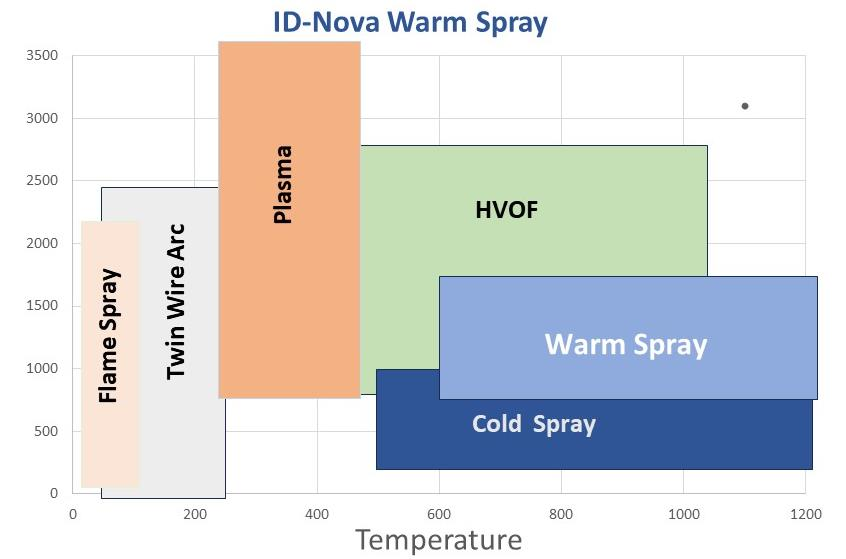
Warm spray sits between HVOF and cold spray. Auxiliary gas lowers flame temperature and increases gas volume, which raises velocity. The usual target temperature is 600–1500 °C.
Cold spray heats a large gas flow up to the target. ID-Nova Warm Spray starts from HVOF combustion gas and dilutes it down to the same band.
Which Auxiliary Gas, and How Much
Temperature follows adiabatic flame temperature. Particle acceleration follows drag, which scales with gas density. Density can be set with the auxiliary gas. Properties below are at 1200 K.
| Auxiliary gas | C p (J/kg·K) | Density (kg/m³) | Abs. viscosity (N·s/m²) |
|---|---|---|---|
| Nitrogen | 1182 | 0.28 | 46.3 × 10 −6 |
| Air | 1200 | 0.29 | 50.7 × 10 −6 |
| Argon | 520 | 0.41 | 64.4 × 10 −6 |
| Carbon dioxide | 1280 | 0.45 | 51.1 × 10 −6 |
H 2O | 2320 | 0.18 | 44.2 × 10 −6 |
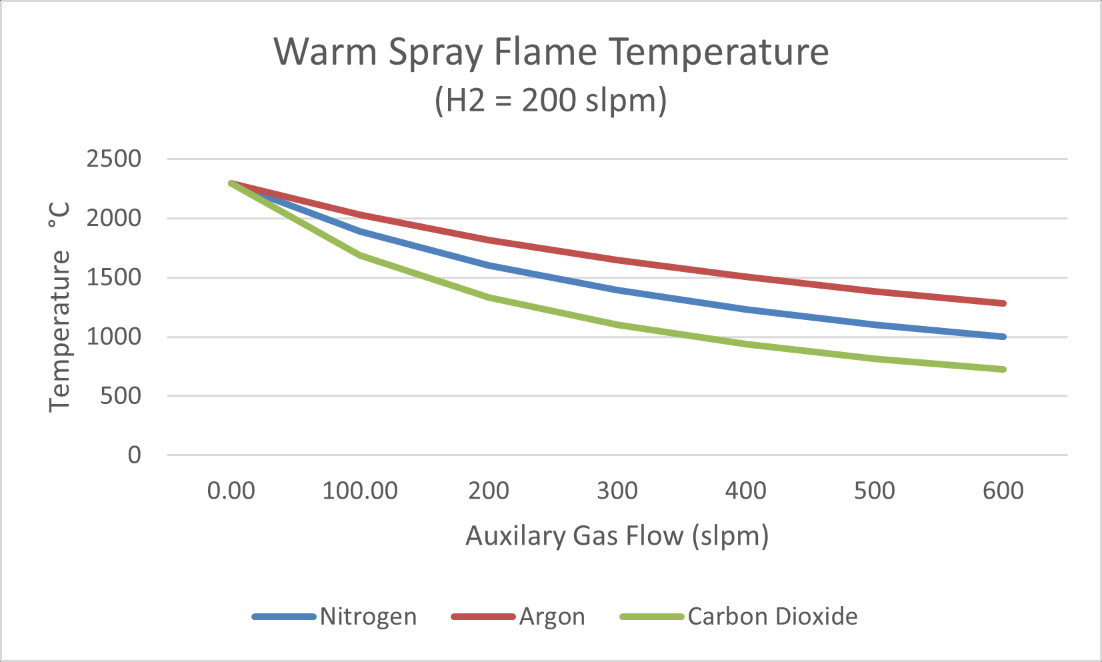
The flame-temperature curves use a baseline hydrogen flow of 200 slpm. Nitrogen, argon, and carbon dioxide each pull temperature down as flow rises. Carbon dioxide drops it fastest. Argon drops it slowest.
Preliminary Results
Shop trials with nitrogen as the auxiliary gas. These numbers are preliminary. They are warm-spray results on the alloys named. They are not the HVOF deposition-efficiency figure used on other pages.
Ti-6-4 · 50% N 2 | IN-625 · 30% N 2 | |
|---|---|---|
| Deposition efficiency | ~100% | ~100% |
| Porosity | 0.2% | 0.2% |
| Hardness | 210 ± 20 HV100 | 325 ± 20 HV100 |
| Oxygen | 1.06% O | — |
| Thickness | — | 2 mm |
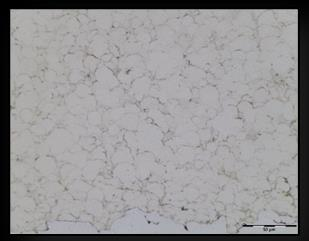
Ti-6-4 with 50% N2

IN-625 with 30% N2
Run it on your alloy
Warm spray is a mode on the ID-Nova platform, not a separate gun family. If the part is temperature-sensitive, or cold spray is priced out, book a trial in North Vancouver.